ALBUQUERQUE AQUIFER
Feb 2026
Albuquerque’s Aquifer Is Real, but It Does Not Live Alone
by Chuck Webster MD, MSIE, MSIS
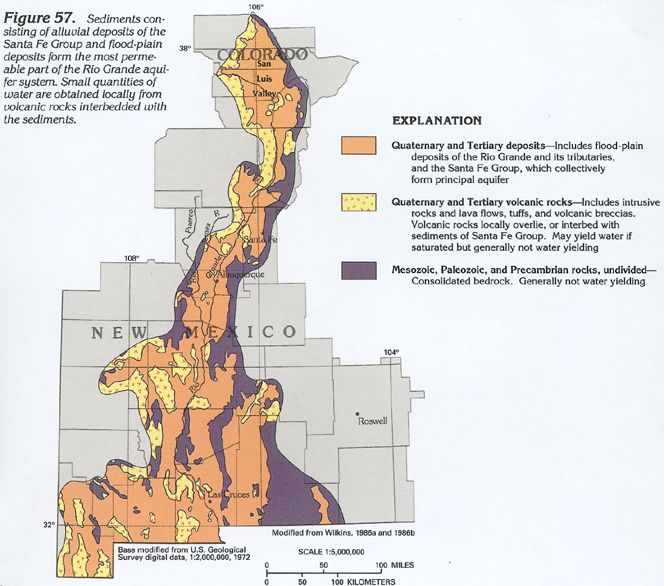
Jan 28, 2026. Over the weeks since I wrote, How Albuquerque’s Water Past Shapes Mirehaven’s Water Tomorrow, time has passed, conversations have accumulated, and my own reading on New Mexico water issues has continued. I’ve read more local reporting, revisited technical studies, and listened more carefully to how people talk about water, conservation, and the future. This follow-up stems from that process. It is not a retreat from my earlier optimism about Albuquerque’s aquifer, but an effort to place that optimism in a wider context.
In my earlier article, I made a reassuring and, I still believe, largely accurate case that Albuquerque sits atop a highly productive aquifer and manages it with unusual care and discipline. Compared with Las Vegas and Phoenix, Albuquerque looks almost prudently dull: pumping less, replenishing more, planning, and adjusting behavior before crisis forces change.
That picture remains correct. But it is also incomplete.
Albuquerque’s water story is, by necessity, a local one. Water management in New Mexico is not.
Albuquerque as an Exception
Albuquerque stands out in the Southwest, and even more so in New Mexico. The city reduced per-capita water use dramatically over the past three decades, integrated surface water into its supply, invested in monitoring and modeling, and accepted legally enforced limits once groundwater decline became undeniable.
Many other regions of New Mexico have not followed that path. In some cases, they simply could not. Across the state, groundwater depletion remains widespread and persistent. In basins such as the Estancia, Mimbres, Pecos, Gallup, and High Plains regions, groundwater withdrawals continue to exceed natural recharge, sometimes by large margins. In several of these areas, pumping draws from water that accumulated hundreds or even thousands of years ago, making it effectively nonrenewable on human time scales.
Statewide, more than half of New Mexico’s total water supply comes from groundwater. Most public water systems depend on it. Yet the level of monitoring, regulation, enforcement, and long-term planning varies enormously from basin to basin.
Albuquerque’s recovery is real. It is also not typical.
Interconnected Systems
This matters for Mirehaven because Albuquerque is not in a hydrological bubble. Groundwater basins connect to rivers, interstate compacts, tribal water rights, agricultural use, economic pressures, and climate trends that operate on much larger scales than city boundaries.
Climate projections suggest substantial reductions in surface-water availability over the coming decades. As rivers carry less water, demand for groundwater elsewhere in the state will increase. That pressure does not stay politely confined. It moves through legal systems, political negotiations, compact obligations, and eventually physical systems.
Albuquerque’s future water security, therefore, depends not only on what the city continues to do right locally but also on how effectively New Mexico manages groundwater across all its regions.
Lessons from Elsewhere in the West
Looking beyond New Mexico is instructive. No Western state has solved groundwater management everywhere. Significant depletion persists across the region. But states that have slowed or reversed declines tend to share a few characteristics. They invest in data, monitoring, and modeling. They support locally driven management while retaining clear state authority. They define basin-level goals rather than reacting only to a crisis. They treat groundwater and surface water as connected. And they create management tools flexible enough to adapt as conditions change.
New Mexico has pieces of this framework in place, but not yet a fully coordinated statewide system. Albuquerque reflects what is possible when science, governance, law, and public acceptance align. Many other basins are still working toward that alignment.
What This Means for Mirehaven
None of this negates the optimism of my earlier article. Albuquerque’s aquifer is substantial, well-studied, and currently recovering. I still believe that, twenty years from now, Mirehaven residents will enjoy reliable water service.
But that confidence rests on a broader assumption: that New Mexico continues to improve groundwater management statewide, not only where decline has already become undeniable, but before it does.
That surfer riding a wave down Central Avenue still works as an image for me. It captures the feeling that something dependable flows beneath our feet. But the wave does not rise from this city alone. It is shaped by what happens across New Mexico’s aquifers, rivers, laws, institutions, and shared choices. If those systems are managed wisely, the surfer keeps gliding. If not, the water thins, slows, and eventually slips away. The future of that wave, and of Mirehaven’s water security, depends not only on what we do here in Albuquerque, but on what we choose to do together in New Mexico.
- New Mexico 360 Groundwater Report (January, 2026, New Mexico Groundwater Alliance)
- Groundwater Management Frameworks from Other Western States (2026, New Mexico Groundwater Alliance)