GENERAL INTEREST
SEPTEMBER 2026

Heat stress
by Teresa Lange Reinhard
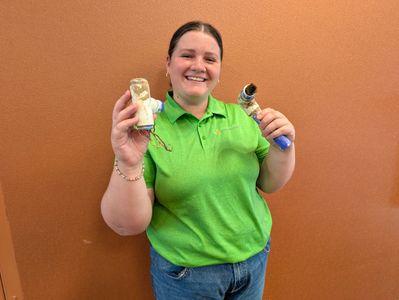
Claire McIntyre, Green Summit Account Manager, displays irrigation tubing invaded by roots
Photo by Teresa Lange Reinhard
August 12, 2026. Extreme heat, scant monsoon rain, and growing irrigation concerns dominated this morning's meeting of the Landscape & Trails Committee (LTC). Volunteers and landscape managers reviewed Mirehaven's commitment to protect common-area plants while conserving water.
The meeting included Julie Karl of Associated Asset Management (AAM), Green Summit employees, 10 parcel walkers, several water dogs and resident guests. Parcel walkers monitor common areas for dead or diseased plants, trees, weeds and invasives. Water dogs track irrigation schedules, watch for leaks and help identify problems early to reduce waste and costs.
The committee trains both volunteer groups, who flag problem areas and submit work orders for Green Summit crews. Karl said plants in raised beds behind the Amenity Center will be replaced this fall. Future budgets may also allow replacement of aging ornamental grasses in front of the Amenity Center.
Mirehaven is using an extreme watering schedule because of sustained high temperatures, adding one watering day to help trees and plants survive. Participants noted that Albuquerque has recorded 68 days at or above 90 degrees, is behind average monsoon rainfall and has reached triple digits at least 10 times this summer.
Joseph Nechvatal, Green Summit account manager, urged residents to check yard irrigation systems at least twice a year for leaks or popped emitters. Claire McIntyre, Green Summit’s incoming account manager, showed irrigation tubing clogged and cracked by roots, illustrating how hidden damage can waste water.
The LTC writes a quarterly newsletter which Karl emails to residents; the newsletter includes common area plans as well as residential landscape tips. Residents who are not receiving updates should contact AAM or check the Estates at Mirehaven website. Upcoming education includes a September workshop with Master Gardener Randy Verble on backyard redesign and a possible future lecture on honeybees.
Residents may attend monthly LTC meetings as guests. The next meeting is scheduled for 9 a.m. September 9 in the Manzano Room at the Sandia Amenity Center.
State of the City
by Cathy Carter
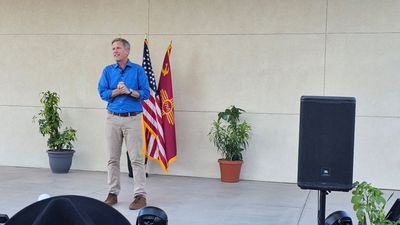
Mayor Tim Keller
Photo by Kim Hafermalz
August 15, 2026. This evening the city of Albuquerque hosted the State of the City address. The city recently opened the Route 66 Visitor Center at 12300 Central Avenue, welcomed everyone who wished to come. The event was built around Tim Keller's annual State of the City speech to tell all Albuquerque residents where the city is now and where he plans to take it in the next year.
The mayor’s speech (in the video below) focused upon the history of the region and the concepts of scarcity that evolved from its history of living in the high desert and contrasting it to the philosophy of abundance. Keller wants the city to begin operating with a mindset of abundance to provide more for the people of Albuquerque.
In a post on social media, the mayor wrote:
”Yesterday’s State of the City, I laid out a vision for Albuquerque’s next chapter: moving from a mindset of scarcity to one of abundance.
That means putting public safety first, reducing the everyday friction government can create, and putting more of our city’s land, buildings, and resources to work for the people who own them - you.
We are making government genuinely useful in people’s everyday lives and building a city where more is possible together."
Discussing Low Vision in a Group Setting
by Cathy Carter
August 7, 2026. For Mirehaven residents living with low vision, everyday routines such as reading, navigating a sidewalk, recognizing a neighbor, or handling household chores can require new strategies and extra patience. On Friday, several residents gathered at Rudi Andrus’ home to share what helps, what frustrates, and how friends and family can offer support.
Low vision can be caused by several medical conditions, including macular degeneration, geographic atrophy, and diabetic retinopathy. Its effects can be far-reaching: using a computer or tablet, completing household tasks, walking safely, and seeing facial features clearly all become more difficult.
During the meeting, group members discussed their adjustments to make daily life easier. These included accessibility features on computers and tablets, using a walking stick outdoors for greater confidence on uneven sidewalks, and developing ways to manage household chores.
The conversation also focused on how friends and family can help. Because low vision can make it hard to recognize faces, some residents said Mirehaven friends now announce their names when approaching, sparing them from having to ask who is there.
The next meeting will be on Friday, September 16 at 2 p.m. at Cathy Carter’s home. Anyone interested in the group should contact Rudi Andrus at rudiandrus@gmail.com
Tour of the Indian Pueblo Cultural Center
by Cathy Carter
Click on image to enlarge
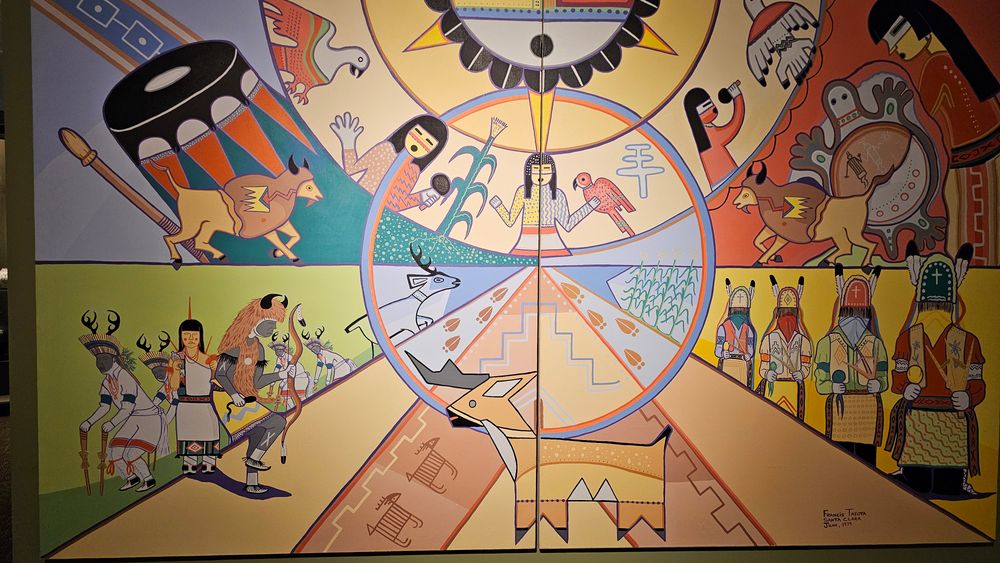
Mural
Photo by Kim Hafermalz
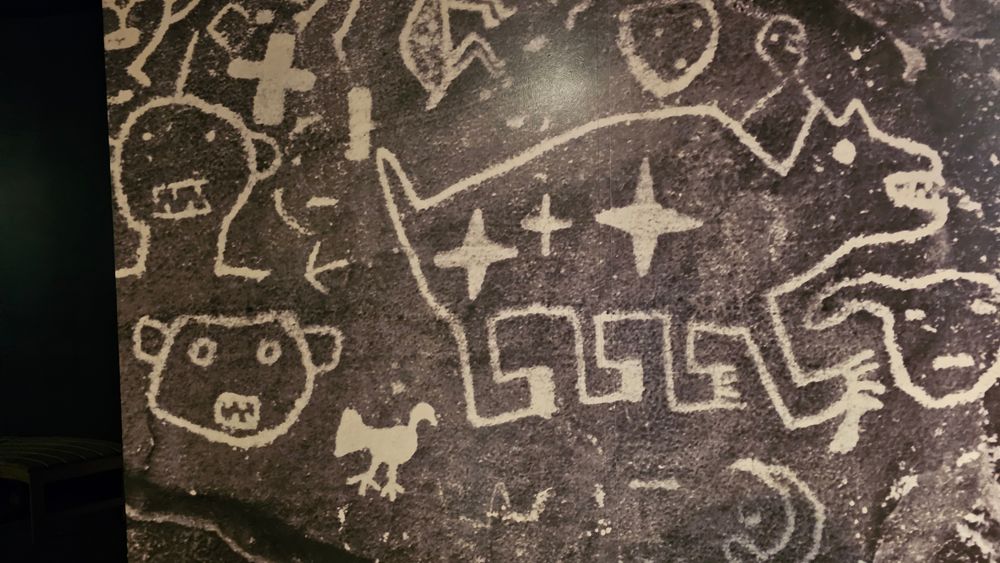
Petroglyph
Photo by Kim Hafermalz
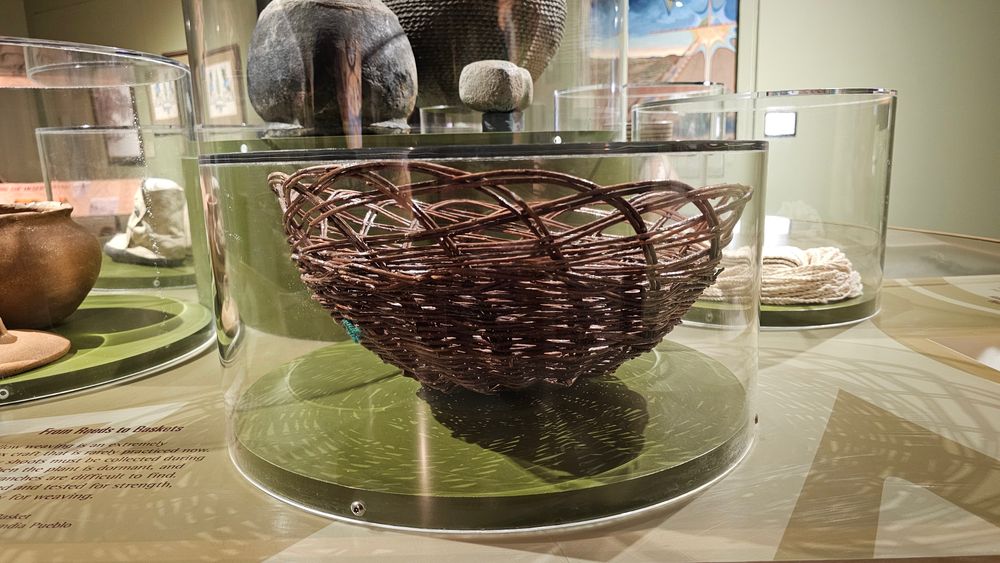
Basket
Photo by Kim Hafermalz
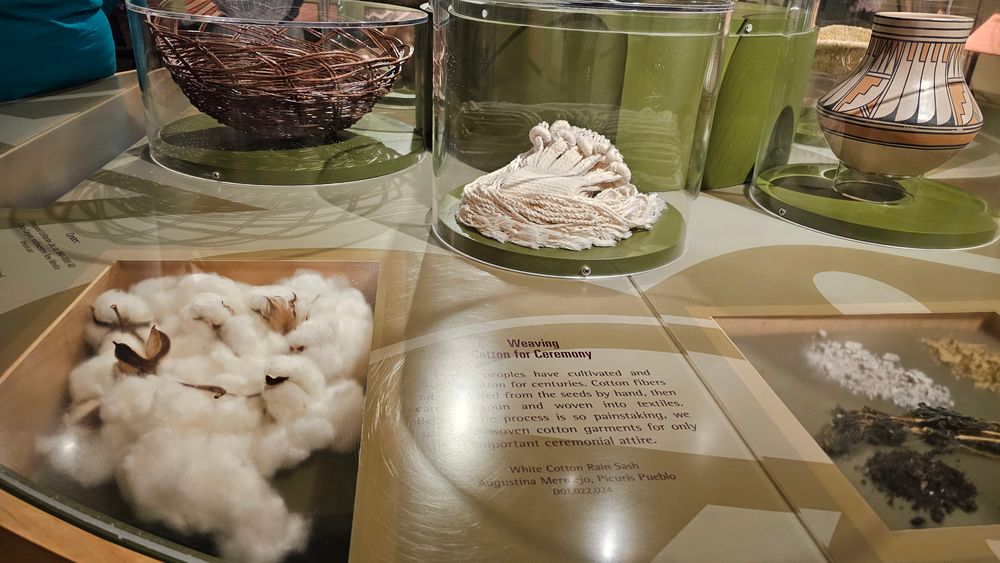
Cotton
Photo by Kim Hafermalz
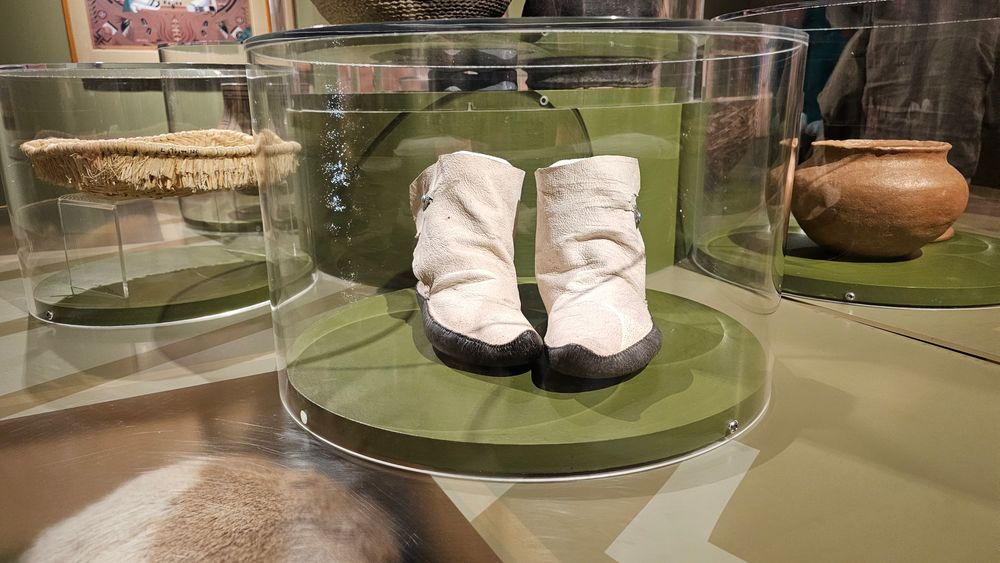
Deer Moccasins
Photo by Kim Hafermalz
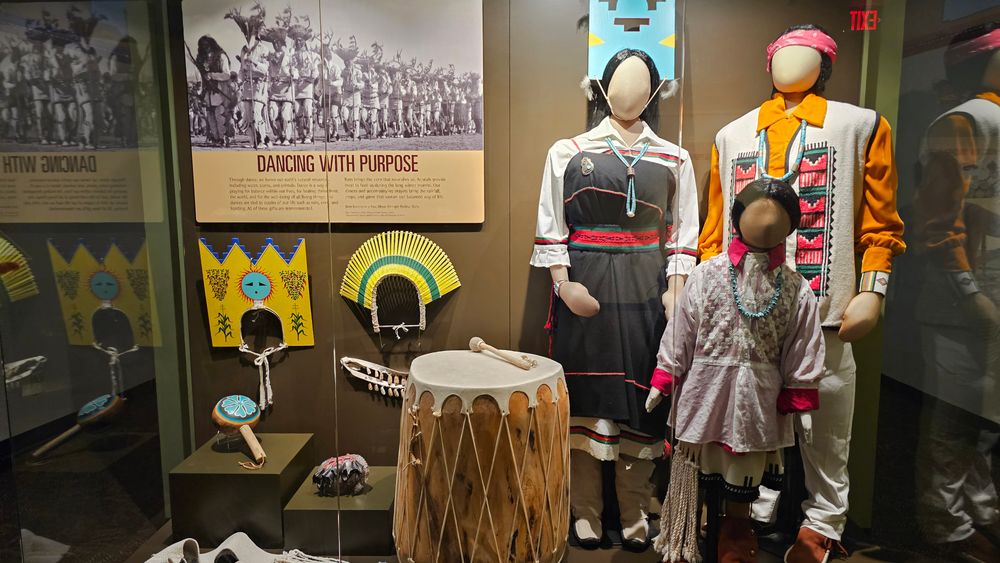
Dancing Attire
Photo by Kim Hafermalz
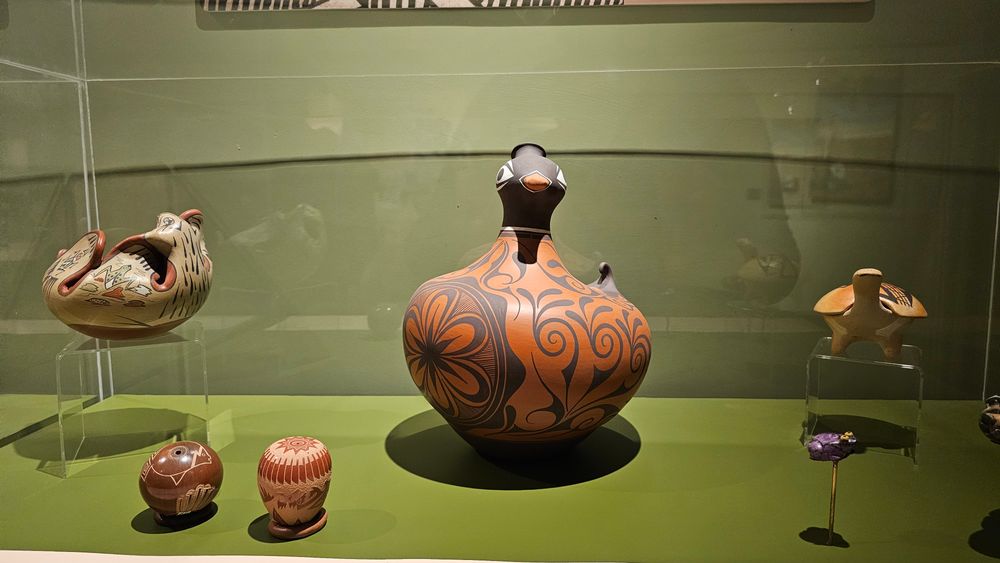
Animal pottery
Photo by Kim Hafermalz
August 11, 2026. Nearly two dozen Mirehaven residents traveled to the Indian Pueblo Cultural Center (IPCC) today for a docent-led tour of the museum. The docent guided the group through the museum room by room, explaining the meaning of the exhibits.
One room contained examples of the food that the Pueblo people gathered or grew during the early parts of their habitation. Another room displayed clothing that they obtained from the animals that surrounded them. An impressive mural in one room consists of stylized versions of petroglyphs from Petroglyph National Monument.
The docent discussed the diverging concepts that pueblo people and modern people have about the natural world. She said that modern, non-native people tend not to consider preserving the land and traditions for future generations. Pueblo people, in contrast, believe that the earth must be protected and preserved for future generations, she said the native people have great respect for the earth and the necessities of life that it provides.
The docent said that in her opinion, the Pueblo people were among the first ecological peoples because they used what was available to them from nature. This included dirt, water, and straw to make adobe for the walls of their dwellings, skins, and feathers from the animals around them for clothing, and places to grow their crops for food.
Many of the museum rooms contained pottery painted not just with decorations, but with symbols of the earth, water, and images of their gods.
Following the tour, several of the residents dined at the Indian Pueblo Kitchen, the restaurant inside the IPCC museum. The food served featured flavors of the Pueblos with an upscale presentation. The restaurant is open from 9:00 a.m. to 5:00 p.m. daily.
The IPCC organizes native dance demonstrations on the weekends in the Fall, Saturday and Sunday, 11:00 a.m. and 2:00 p.m.
Quelab Makerspace Offers Creative Outlet
by Chuck Webster
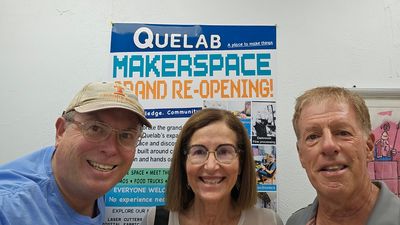
Chuck Webster, Nancy Croker, and Joe Gorvetzzian.
Photo by Chuck Webster
July 26, 2026. Quelab, a nonprofit makerspace at 1511 Central Avenue NE in Albuquerque, celebrated its Grand Re-Opening July 25, offering Mirehaven residents access to woodworking, 3D printing, electronics, robotics, fiber arts and other equipment not available within the community.
A makerspace is a shared workshop where members use tools and technology to build, repair, invent, and create. Quelab's facilities include laser cutters, computer-controlled cutting routers, welding and metalworking equipment, a wood shop, electronics and robotics tools, screen printing and fabric arts.
The organization moved from its former Haines Avenue location to a former school building on Central Avenue about a year ago. The new facility is bright and spacious, with former classrooms converted into specialized workshops, laboratories, and gathering spaces.
During the reopening, members demonstrated projects ranging from cosplay costume construction to robotics. One member demonstrated Robby McRobotFace, software that may eventually become part of an interactive robot and was developed with assistance from Claude artificial intelligence.
Mirehaven has interest groups but no dedicated makerspace. Quelab provides an off-campus workshop for residents whose retirement interests include sawdust, soldering irons, sewing machines, and robots.